
AI-Assisted Requirements Specification: A Common Language Between Business, IT, and AI Agents
The success of an IT development project is often determined before the first line of code is written – at the stage where business needs are transformed into specifications.
In many organizations, the requirements specification is still treated as a one-time document. We gather the requirements, describe the functionality, hand it off to the development team – and then the project moves forward. In reality, however, business needs change, new decisions are made, previously unknown exceptions arise, and the system is constantly evolving.
Therefore, the expected functionality must be described with such detail and precision that the specification leaves no room for critical interpretation – neither for developers and testers nor for coding and testing agents. This prevents the implementation from deviating significantly from the intended and documented behavior.
AI-assisted requirements specification (or AI-Assisted Specification) offers a solution to this challenge.

What Makes a Good Specification?
A good specification is not simply “detailed”; it must establish a common basis for understanding among stakeholders in business, technology, and testing:
- From the business perspective, it is expected to clearly describe the business objective, the scope, and the key decision points.
- For developers, it is useful if it is executable, leaves no room for critical interpretation, and addresses exceptions and alternative processes.
- From a testing perspective, it is important that the specification be verifiable and usable at various testing levels—and that it also address exceptions and alternative processes.
- In addition, it is important that it include both architectural and logical system designs.
All of this is only possible if the documentation is structured, maintainable, version-controlled, referenceable, and searchable. Today, a new consideration has also emerged: the specification must be interpretable not only by humans but also by AI agents.
Inadequate Specifications – Creeping Consequences
A poor specification rarely causes an immediate, obvious problem. Rather, it gradually introduces uncertainty into the project.
This can be caused, for example, by missing or undocumented decisions, inadequate handling of changing business requirements, failure to track the effects of changes, or simply by the failure to update the specification in parallel with development.
As a result, the specification, the source code, and the system’s actual operational logic drift apart over time. In such cases, it becomes increasingly difficult to determine whether a given behavior is the result of a conscious decision, a developer’s interpretation, a previous compromise, or a bug.
This not only slows down development but also weakens quality assurance, auditability, and change management.
AI-Assisted Requirements Specification: Purpose
The purpose of AI-Assisted Specification is to help experts create specifications that are
- unambiguous,
- sufficiently detailed,
- and provide a reliable foundation for development, testing, and future modifications.
In addition, it supports maintainability and version control and makes it possible to track which changes were incorporated into the system and in response to which business needs.
Important: AI does not take over the role of human experts. It does not make decisions on behalf of the business, nor does it replace the architect, developer, or tester. Instead, it uncovers missing or ambiguous information, identifies questions and decision points, structures descriptions, and helps ensure that decisions are incorporated back into the specification in a documented form.
Thanks to AI-Assisted Specification, the requirement specification is not a static document but rather an up-to-date knowledge base that evolves alongside the system.
Why Is This Necessary?
Digital development projects are rarely linear. They are shaped by multiple stakeholders, multiple systems, multiple integrations, and a constantly changing business environment.
During a large-scale enterprise development project, a multitude of business rules, permissions, data fields, validations, exception handling mechanisms, and integration points must be coordinated.
Furthermore, the specification is used by a wide variety of stakeholders: the client, business stakeholders, business analysts, product owners, architects, developers, testers, and other experts. Each role expects different information and levels of detail from the same documentation.
It is a reasonable expectation that every critical detail be included in the specification, but in practice, this is not always fully achieved on the first attempt. Therefore, it is very helpful to have a process that systematically identifies these gaps, prioritizes them, and feeds them back into the specification.
AI-Assisted Specification: How It Works
Step 1: Processing the Existing Specification
The first step in the process is to process and logically parse the existing specification.
In this step, a GraphRAG (graph-based RAG) is built, which combines the traditional Retrieval-Augmented Generation (RAG) method with knowledge graphs.
We create a structured knowledge base from the existing specification based on various logical frameworks. We group related functions and the information required for their operation and identify any potential gaps.
Step 2: Interview Preparation
In this step, more than a dozen agents perform a detailed gap analysis of the existing specification. The agents then group the resulting questions according to the role of the expert who should answer them. In addition, they prioritize the list of questions for each role and prepare possible answers to accompany the questions.
Step 3: Human-AI Interview
During the human-AI interview, the various experts involved in drafting the specification answer the prepared questions.
Respondents may include business representatives, Product Owners, architects, developers, security experts, or other stakeholders.
Step 4: Refining the Specification
The expert responses obtained during the interviews are then entered into the GraphRAG. Based on these, the system refines any missing information, exceptions, and special cases.
This step also includes a consistency check, which helps identify any potential contradictions and align the new information with the existing parts of the specification.
Step 5: Implementation Plan: Outputs
Based on the completed GraphRAG, various outputs can be generated from the knowledge base – that is, the structured specification – such as:
- a detailed development plan,
- a revised, updated, restructured, and easily understandable version of the original specification,
- or an extract intended for developer/tester AI agents.
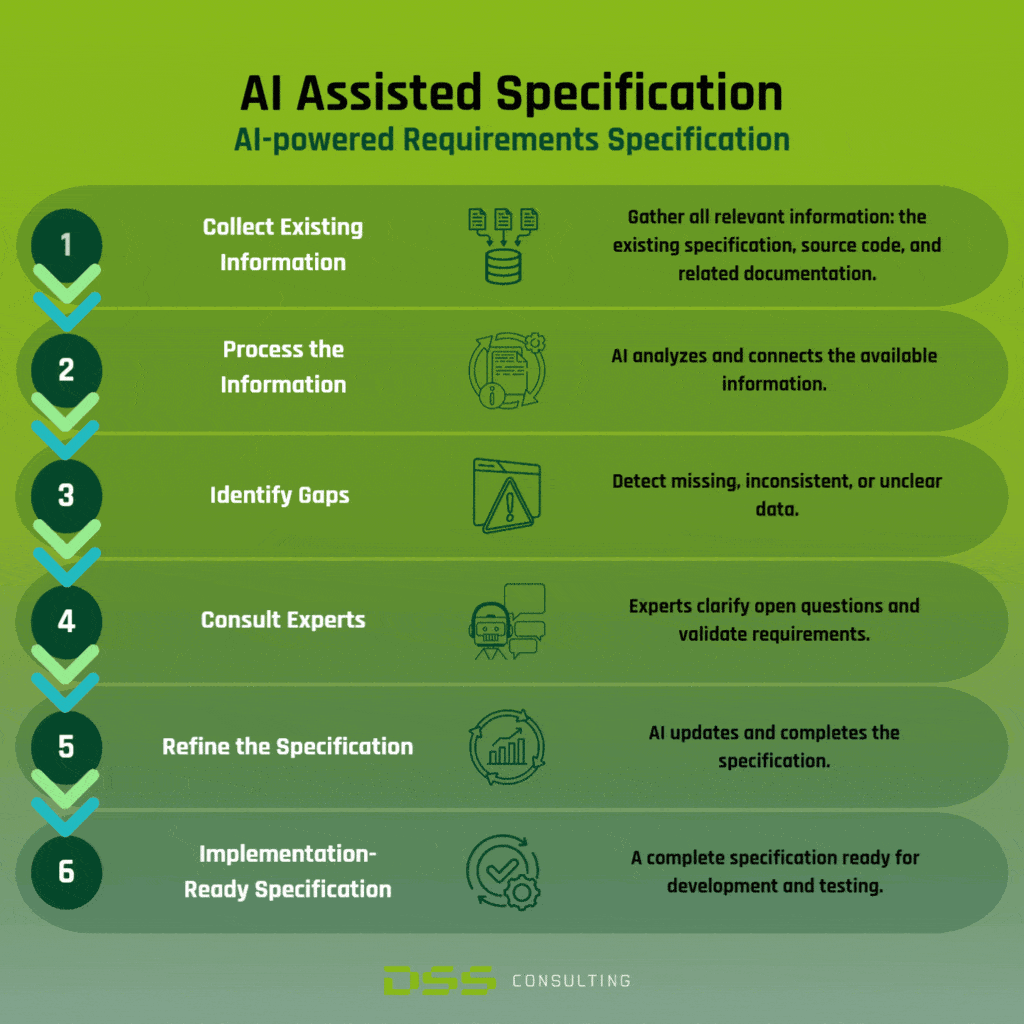
It is important to note that the process is iterative: it can be repeated until there are no remaining significant gaps that the developer – or later, an AI agent – would have to fill in with their own assumptions.
AI-Assisted Specification: Benefits
The greatest benefit of AI-assisted specification is that it reduces the risks arising from differing interpretations. The same structured documentation can be used by the business analyst, architect, developer, tester, and AI agent.
This results in faster project preparation, less uncertainty, better change management, and more documented decision-making. In addition, alignment between the specifications and the system becomes sustainable in the long term – not just during the first development cycle, but throughout the entire lifecycle.
It’s also important to note that this approach is equally applicable in large enterprise environments. The critical factor is not the size of the system, but whether the specific development area can be described and structured.
Conclusion
The requirements specification is not merely an administrative byproduct of the project, but one of the most important management tools for development.
AI-assisted specification helps ensure that business requirements are transformed not merely into a document, but into a structured, maintainable, and continuously updated knowledge base – a foundation that supports development, testing, change management, and future decision-making.
So, the question isn’t whether it’s worth involving AI in the specification process – it’s how long we can afford not to do so.
In your organization, is the specification more of a one-time document or a continuously updated knowledge base?
