
Databricks in the Auto Industry: Where AI and Data Platforms Deliver Immediate Value
In earlier blog posts, our focus was on why Databricks has become highly relevant as a unified data and AI platform, and how this plays out in sectors such as banking and insurance. This time, the focus shifts to automotive – an industry where data volumes, operational complexity, and AI ambitions are all rising at once, and where the cost of fragmentation is becoming increasingly visible.
Below are four examples of where a unified data platform can create measurable impact across the automotive value chain – and why this is becoming a strategic issue, not just a technical one.
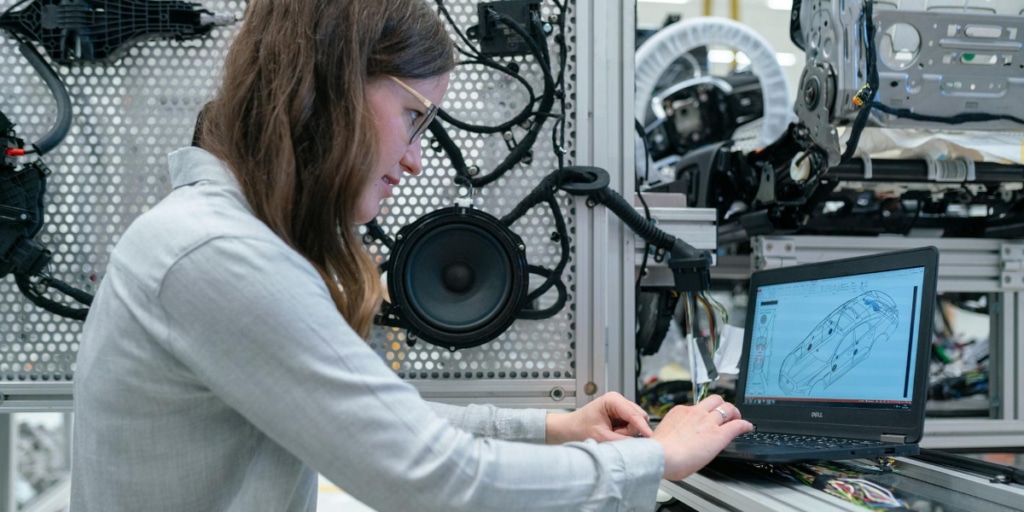
Automotive Is Entering a New Era – And Data Will Define the Winners
The automotive industry is going through one of the most complex transitions in its history. Electrification, software-defined vehicles, ADAS, and supply chain volatility are reshaping how OEMs and suppliers design, build, and operate products.
At the same time, the volume and diversity of data have expanded dramatically. Vehicles produce rich sensor streams, manufacturing environments generate continuous IoT signals, and engineering teams rely on increasingly complex validation and simulation datasets.
What makes this moment particularly important is that these pressures are converging. Automotive companies are not simply facing a data growth problem – they are facing a coordination problem across fragmented systems and functions.
That is why the underlying data platform is becoming a strategic decision, not just an infrastructure topic.
Why Databricks Is Becoming Relevant in Automotive
Most automotive organizations still operate with siloed environments across engineering, manufacturing, supply chain, and enterprise systems. This limits visibility, slows down decision-making, and makes it difficult to act in near-real time.
A unified data and AI platform changes this dynamic. Instead of moving data between disconnected systems, organizations can work on a single governed foundation where sensor, IoT, ERP, and validation data are integrated, processed, and used for analytics and AI in one place.
This is also increasingly relevant from a regulatory standpoint. UN ECE R155 and R156 – the cybersecurity and software update regulations now mandatory across major markets – require traceable, auditable data management across the vehicle lifecycle. ISO 26262 functional safety requirements add further pressure on engineering teams to demonstrate data lineage and validation integrity. A unified platform makes compliance a byproduct of good architecture, not a separate effort.
The result is a shift on several levels:
- from delayed reporting to near-real-time decision-making
- from isolated datasets to a unified operational view
- from experimental AI projects to scalable, production-ready use cases
This is not just better efficiency. It is a different operating model for how products are validated, factories are managed, and risks are handled across the value chain.
Databricks in the Auto Industry: High-Impact Use Cases
The real value becomes clear when looking at practical Databricks use cases. The following four examples show where impact can often be seen early.
1. ADAS and Autonomous Validation – From Fragmented Analysis to Scalable Insight
ADAS and autonomous systems validation is one of the most data-intensive challenges in automotive. A single test vehicle can generate terabytes of camera, LiDAR, radar, and ECU data per day -and a full validation program can reach petabyte scale. When these datasets sit across separate tools and workflows, validation slows down and rare safety-critical scenarios are easy to miss.
With a unified platform, multimodal sensor data streams can be processed and queried together at scale, including geospatial analysis across test routes and automated detection of edge cases that would otherwise require manual review. Engineering teams can run scenario comparisons across model versions, track coverage gaps systematically, and accelerate the path from test data to validated insight.
This also directly supports traceability requirements under ISO 26262 and homologation processes, where the ability to demonstrate what was tested – and when – is as important as the test results themselves.
Typical impact:
- 30-50% reduction in validation cycle time
- 10x increase in analyzable test scenarios without proportional team growth
- Earlier identification of edge cases, reducing late-stage engineering changes
- Audit-ready traceability across the full validation dataset
2. Shop Floor Intelligence – From Reactive Operations to Predictive Intervention
Manufacturing environments generate a constant stream of real-time signals from sensors, PLCs, and production systems – yet many operational decisions still happen reactively, after problems appear. This creates avoidable downtime, scrap, and yield loss.
By streaming sensor data into a central platform and applying anomaly detection models, operations teams can identify issues earlier and intervene before failures cascade. Dashboards can be unified across plants while preserving existing BI investments, giving leadership a consistent view without replacing tools that already work.
Typical impact:
- 10–30% reduction in unplanned downtime
- 5–15% improvement in OEE (Overall Equipment Effectiveness)
- €1–3M annual savings per plant for a large-scale manufacturer
- Unified visibility across sites, without replacing plant-level systems
3. Digital Supply Chain Intelligence – From Delayed Reaction to Earlier Risk Detection
Automotive supply chains are highly interconnected and increasingly volatile. When supplier data, logistics signals, and demand forecasts remain separated, disruptions are detected late and response options narrow quickly.
A unified platform makes it possible to combine these signals and apply predictive models for earlier warning and better coordination. Supplier risk scoring, demand sensing, and inventory optimization can operate on the same data foundation – reducing the gap between what is happening and when the organization can respond.
Typical impact:
- Earlier detection of supplier risks, days before they become operational issues
- 15–25% improvement in forecast accuracy for critical components
- Better coordination between planning and execution layers
- Reduced safety stock requirements without increasing supply risk
4. R&D Productivity and Cost Reduction – AI as a Force Multiplier
Engineering and R&D account for a major share of cost and complexity in automotive. As products become more software-driven, the pressure to accelerate testing, reuse knowledge, and improve engineering productivity also increases.
AI and GenAI can support multiple stages of the development lifecycle – from automated test case generation and requirements analysis to document search and cross-team knowledge reuse. Engineers who previously spent significant time on repetitive validation tasks can shift toward higher-value work. Teams working on similar problems in parallel can find and build on each other’s work instead of starting from scratch.
A Nucleus Research study cited in Databricks’ automotive benchmarks puts the average three-year ROI from these types of implementations at 482%, with a payback period of just over four months.
Typical impact:
- 40–60% faster test case generation
- Reduced duplication of effort across engineering teams
- Better access to institutional knowledge across programs and platforms
- Measurable improvement in time-to-validation for new features
What Kind of Results Can Automotive Companies Expect?
When these use cases are combined, the impact reaches beyond individual teams. It affects engineering speed, operational resilience, and overall business performance.
Benchmarks point to strong multi-year ROI, payback measured in months rather than years, up to 40% infrastructure cost reduction, and meaningful productivity gains across data and engineering teams.
Beyond the financial case, the strategic value is equally important. Organizations gain a more unified data foundation, reduce fragmentation across systems, and make decisions more consistently across domains – which matters especially as product complexity continues to increase.
Databricks Transformation Without Disruption: The Strangler Pattern
A common concern in automotive is the complexity of legacy landscapes. Replacing everything at once is rarely realistic and usually too risky.
The more effective path is incremental modernization. New capabilities are introduced alongside existing systems, pipelines run in parallel, results are validated domain by domain, and legacy components are retired only when the new approach is proven.
A typical migration path looks like this:
- Start with one or two focused use cases – validation analytics or predictive maintenance are common entry points
- Run the new pipelines in parallel with existing systems, comparing outputs before shifting any decisions
- Gradually expand to additional domains while keeping legacy as fallback
- Stop further development on the legacy side once a domain has been successfully migrated
This creates a controlled Databricks transformation path where risk is reduced, continuity is preserved, and value is realized step by step.
How DSS Consulting Supports This Journey
Technology alone is not enough. The delivery model matters just as much.
Our approach follows a structured progression: a Discovery phase to map the current landscape and identify the highest-impact use cases; a Pilot phase to prove value in parallel with existing systems; a Scale phase to expand what works; and an ongoing Partnership to support optimization and roadmap evolution.
This makes the transformation measurable, lower-risk, and aligned with business priorities from the start – not just from the platform side, but from the process and organizational side as well.
Closing Thought
Automotive is moving toward a real-time, data-driven operating model. The question is no longer whether this shift will happen, but how quickly organizations can build the platform foundation required to support it.
Data platforms are becoming central to how vehicles are validated, factories are optimized, supply chains are managed, and engineering work is accelerated.
Those who move early will not just improve efficiency: They will be better positioned to shape how the next generation of automotive products is designed, built, and operated.
If you are navigating a similar transformation or evaluating data platform options for your automotive operations – it would be worth a chat.
